


14-06-2019, 04:41 PM
List of earthquakes over the last 10 days.
https://www.ign.es/web/ign/portal/vlc-ul...54yLUaYTi4
Modify message
https://www.ign.es/web/ign/portal/vlc-ul...54yLUaYTi4
Modify message
![[-]](https://fuerteventura.click/images/collapse.png "[-]") |
| islands canary volcanic activity earthquake |
|
Volcanic activity in Canary Islands 2019
|
|
14-06-2019, 04:41 PM
List of earthquakes over the last 10 days.
https://www.ign.es/web/ign/portal/vlc-ul...54yLUaYTi4 Modify message
1 user says Thank You to jand for this post
More of the "screw " earthquakes.
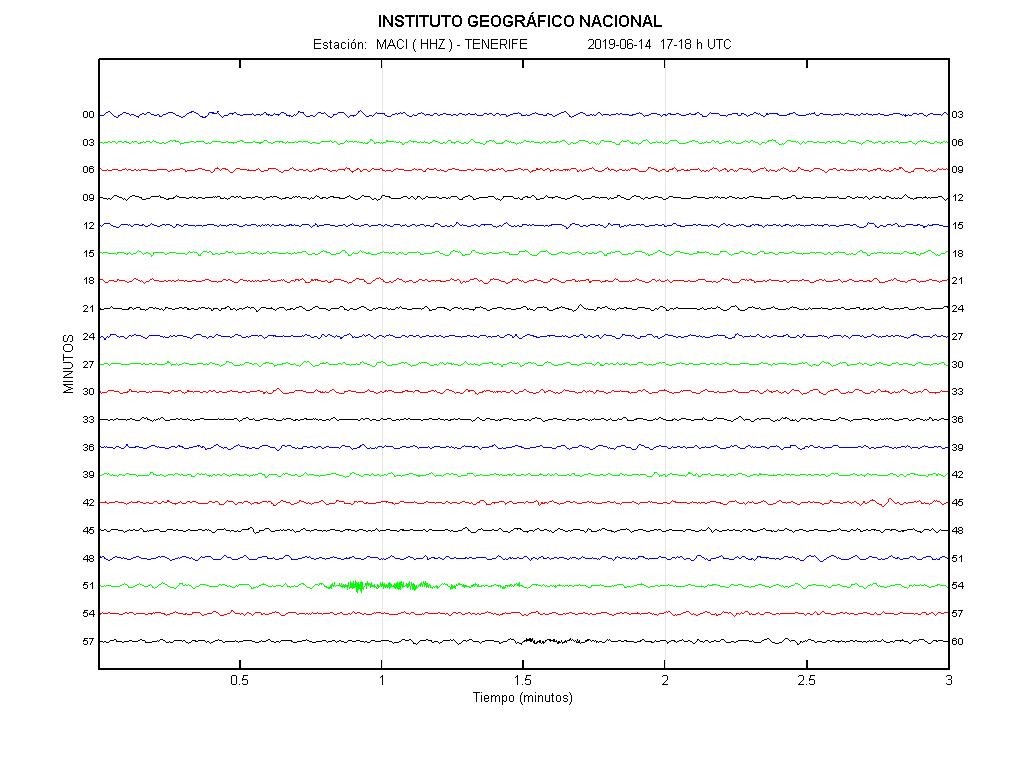
1 user says Thank You to jand for this post
14-06-2019, 06:48 PM
"You also get long-period (LP) earthquakes under volcanoes as bubbles form and escape from the magma during its ascent. Unlike VT earthquakes, LP earthquakes gradually begin and then fade away rather than being abrupt Events. So, if a swarm of earthquakes under a volcano is a combination of VT and LP Events, it is a pretty good sign that the earthquakes are being caused by magma moving into shallower parts of the volcano. However, as the magma gets closer to the surface, VT Events tend to go down as LP Events increase. They can also occur as hybrid (or mixed) earthquakes that have some of the VT and LP characteristics.
A third type of shaking can occur under volcanoes and that is harmonic tremor. This is small but constant shaking possibly caused by the turbulent motion of the magma in the conduit. Typically when volcanologists are watching a volcano that is restless, the onset of harmonic tremor is a good sign that an eruption is likely to occur in minutes to days. These three types of earthquakes—VT, LP and harmonic tremors—are the clues that volcanologists use to determine if the volcano is heading towards an eruption (along with the suite of other volcano monitoring tools). All of these earthquakes can occur at a volcano that does not end up erupting, so putting all the clues together is vital for an accurate forecast. Volcanologists also use seismic information to look for eruption Events like explosions and lahars (mudflows) as they can also produce their own, distinct earthquakes. TRENDING NOW Science The Limits of Human Endurance Might Be Our Guts And if that wasn't tricky enough, earthquakes can occur under volcanoes that have nothing to do with magma. Places with abundant volcanoes also tend to be riddled with faults, so Earthquake swarms that are merely tectonic are common. What volcanologists look for to determine if an Earthquake is potentially related to magma movement or just fault motion is if the Earthquake was caused by dilation (opening) of the crust (magma movement) or some other type of motion (tectonic). Earthquakes can also be generated in the shallow crust (a few kilometers below the surface) by hot fluids in the volcano's hydrothermal fluids. All the water that percolates through the crust over volcanoes can heat up (sometimes to the point of becoming a supercritical fluid) and as those fluids move, the accompanying change in pressure can fracture the rocks around the fluid. If you look at places where geothermal energy is being tapped or at a restless caldera like Yellowstone, Earthquake swarms are common from hydrothermal fluids. If you watch webicorders that volcanologists have installed at many volcanoes, you can see the different types of earthquakes as they occur. However, seismometers like these also pick up earthquakes that happened all over the world or even non-geologic shaking like truck, people or wind. Although it is easy to watch these near-realtime records of volcanic shaking, it takes training to interpret all those blips into a forecast for a volcano. USGS-PNSN, MODIFIED BY ERIK KLEMETTI. So, earthquakes are a great tool for understanding what might be going on under a volcano, both during times that it might be heading towards an eruption or periods when all is quiet. The Earthquake record at Mount St. Helens in Washington shows how even during times before and after eruptions (2002-2012), the earthquakes deep under the volcano don't stop—that's because magma is always moving, cooling, degassing and recharging with new magma. Calling a volcano "dormant" is a bit of a misnomer as the only part that is quiet is the top and really, volcanoes spend most of their life not erupting. Those earthquakes remind us that volcanoes are always rumbling." https://www.wired.com/2015/08/whats-quak...no-erupts/
1 user says Thank You to jand for this post
14-06-2019, 07:01 PM
Monitoring Volcano Seismicity Provides Insight to Volcanic Structure
Moving magma and volcanic fluids trigger earthquakes. Many processes in and around volcanoes can generate earthquakes. Most of the time, these processes are faulting and fracturing that does not lead to an eruption. However, volcanic earthquakes do occur as magma and volcanic gases rise to the surface from depth, which involves significant stress changes in the crust as the material migrates upward. Volcano seismologists study several types of seismic Events to better understand how magma and gases move towards the surface: Volcano-tectonic (VT) earthquakes represent brittle failure of rock, the same process that occurs along purely "tectonic" faults such as the San Andreas Fault. At volcanoes, VT Events can occur due to "normal" tectonic forces, changing stresses caused by moving magma, and movement of fluids through pre-existing cracks. Distinguishing between these various processes can be tricky and often requires data from other disciplines (geodesy, hydrology, gas geochemistry, and geology) to work out what's going on. Seismogram signal examples from volcanic earthquakes: volcano tectonic (VT) Low Frequency (LF)/Deep Long-Period (DLP), hybrid (mix of VT and LF), very low frequency (VLF), and Tremor. (Click image to view full size.) Seismogram signal examples from volcanic earthquakes: Volcano Tectonic (VT) Low Frequency (LF), hybrid (mix of VT and LF), Very Low Frequency (VLF), and Tremor. Volcano name/date in lower left. Long-period (LP) or low-frequency (LF) earthquakes are caused by cracks resonating as magma and gases move toward the surface. They are often seen prior to volcanic eruptions, but their occurrence is also part of the normal background seismicity at some volcanoes and their occurrence does not necessarily indicate that an eruption is imminent. LF Events can also be produced by non-magmatic processes, most notably glacier movement. Tremor is a continuous high-amplitude seismic signal that can be caused by multiple processes, including long-lived resonance due to extended flow of magma movement through cracks, continuous occurrence of VT or LP/LF Events that are so closely spaced in time that they can't be visually separated, and explosions. Most volcano-related earthquakes are too small to feel, generally quite shallow (usually within 10 km (7 mi) of the surface), and can occur in swarms consisting of dozens to hundreds of Events. Most swarms usually don't lead to eruptions, but most eruptions are preceded by swarms. Therefore, during any heightened periods of seismic activity at a volcano, seismologists work around the clock to detect subtle variations in the type, location, and intensity of seismic activity to determine whether or not an eruption may occur. https://volcanoes.usgs.gov/vsc/images/im...w_470h.png https://volcanoes.usgs.gov/vhp/earthquakes.html
1 user says Thank You to jand for this post
14-06-2019, 07:08 PM
Interesting Video from USGS showing prelude to an eruption..
https://www.youtube.com/watch?v=JypTLDLA...e=youtu.be
1 user says Thank You to jand for this post
This is a statement just posted on the Facebook Page "volcanes y ciencia hoy - volcanoes and science today".
Yony Torres Elsa aquí en Gran Canaria también pitan los oídos, a veces es tan fuerte que tienen que hablar un poco alto para escuchar bien, se notan las ondulaciones y la gente los días que está fuerte se van pronto a las casas, a partir de las 8 de la tarde, cuando no se nota están hasta las 3 de la mañana. Pregunto por aquí un mucha gente esta pidiendo cita al otorrino. Como han alejado la estación al otro lado de isla, con todas las fallas que hay no se ven en el espectrograma. Si vas girando la cabeza localizo los puntos de donde viene. Uno hacia el de Enmedio ( centro de la isla, Teide, La Palma ) y Sureste y el otro hacia Jandia. Se oyen zumbidos a diferente frecuencia y hacia Enmedio fluctúa. Si giro la cabeza cambia el oído que lo siento, lo que indica que no soy yo. Translated. Yony Torres Elsa here in Gran Canaria also beep the ears, sometimes it is so strong that they have to speak a little high to listen well, the undulations are noticed and people the days that are strong are going soon to the houses, starting at 8 In the afternoon, when you don't notice it's until 3 in the morning. I ask around here a lot of people are asking for an appointment. As the station has gone on the other side of island, with all the faults that are not seen in the spectrogram. If you're turning your head I locate the points where it comes from. One towards the middle (Center of the island, teide, LA Palma) and southeast and the other towards jandia. You hear buzzing at different frequency and towards the middle fluctuates. If I turn my head change the ear I'm sorry, which indicates that it's not me. Yony Torres Me acaba de vibrar el tímpano como el que sacude un trapo I just vibrated the eardrum like the one who shakes a rag.
2 users say Thank You to jand for this post
14-06-2019, 08:09 PM
More comments.
Carlos Seisdedos Garcia Carlos Seisdedos Garcia Yony Torres pues yo soy uno de los que va al otorrino porque me duelen los oídos de hace tiempo y noto que oigo menos, a ver si el dolor va a ser por eso, aunque es sólo uno, estoy al norte de Gran Canaria Johny Torres for I am one of those who go to the ent because my ears hurt a long time and I notice that I hear less, to see if the pain is going to be for that, although it is only one, I am north of Gran Canaria Keko Palma Si, ese zumbido de oídos es como si uno tuviera mosquitos dentro del oído, a mi también me suele pasar y también mareos o vértigos espontáneo de segundos de duración.. Keko Palma Yes, that buzz of ears is as if one had mosquitoes inside the ear, I also usually pass and also dizziness or spontaneous dizziness of seconds of duration..
2 users say Thank You to jand for this post
14-06-2019, 08:48 PM
2 users say Thank You to jand for this post
Latest update courtesy of Enrique.
Translated. "the volcanic system of Tenerife begins to reactivate, a seismic-volcanic swarm to the SW of Pico Viejo, Tenerife, Canary Islands.- we have been signaling signs all afternoon, the ign has located the main, but has not put The rest, you don't know why. To Toro past now we see it, one thing is clear at mid-afternoon, about 16:40 h have started to occur many seismic Events in front of our noses, which appear as many lines that are barely seen in the spectrogram and are not seen in The Seismogram and now they go out. Dozens of earthquakes and microdisks located by the ign in the area of the caldera of ucanca to the SW of pico viejo that tell us that something happens under the central building. At the moment, 42 Events have been located from 16:40 pm to 17:58 pm, including the last two strongest that have reached the magnitude 2 at depths between 10 and 15 km, with Some more shallow and some deeper right in the area of the fonolítica magma chamber that is under the central building and the caldera. And that indicates all this, it is very clear, they are indicating a process of magma pressurization in the area. And that causes it?, it's soon, but most likely it's about contributions of new magma to the reserve of the magmatic magmatic chamber that's been there for hundreds of years under the central building from deeper levels. The Origin of this new magma is possibly the pen that is in the mantle under the canary islands and that generates its volcanism and now flows through regional efforts that late in late "tighten the archipelago". the last two telesismos, an Earthquake of 3.3 in the azores at that of 20:30 h and a 5.1 on the Atlantic Dorsal that also appears as telesismo past 21:20 h in the spectrogram: 2019-06-14 20:11:21.0 38.60 N 29.13 W 5 km M 3.3 AZORES ISLANDS, PORTUGAL 2019-06-14 20:44:54.4 15.40 N 46.60 W 10 km M 5.1 NORTHERN MID-ATLANTIC RIDGE The chemical composition of this magma that is intruyendo a priori would have to think that it would be basaltic and very hot, so it could be happening at this time therefore a mixture of magma and an increase in the temperature of the magma camera, which will be little A little climbing, like a coffee maker making coffee, what mike would say. On surface is soon to locate anything, except the seismicity, but in a few days there could be something in the GPS and even about 30 days the gases will confirm this activity. We'll have to stay tuned. This is how they told us a few days ago in several publications and in this spanish tv report. http://www.rtve.es/noticias/20190611/tei...5301.shtml And it is that it all seems that this volcanic colossus, the largest third on the planet, continues with a firm step towards the reactivation of its volcanic system. Speaking for everyone to understand me, the teide is waking up come on. This doesn't involve a short-term eruption that does. Now that it happens in the medium term (3-12 months) or long term (1-5 years) is not known and must be monitored very carefully as this new activity evolves. For the moment the following is to expect some more seismic activity in coming days, weeks and months and that the rest of parameters begin to show variations such as GPS and the amount of gases (Co2 mainly), in addition to other parameters such as radon concentration . Hopefully this will calm down and go back to sleep, but of course now it doesn't look like it. We'll see what happens. Something if I'm clear, the pevolca should meet to evaluate this new activity in that area as soon as possible. (Enrique)
1 user says Thank You to jand for this post
|
|
« Next Oldest | Next Newest »
|
| Possibly Related Threads... | |||||
| Thread | Author | Replies | Views | Last Post | |
| Canary Islands set for spectacular night sky display with four meteor showers | Johnrgby | 0 | 2,988 |
21-06-2025, 09:39 AM Last Post: Johnrgby |
|
| Majorero olive oil is once again the best in the Canary Islands | TamaraEnLaPlaya | 1 | 4,128 |
23-02-2024, 07:38 PM Last Post: TamaraEnLaPlaya |
|
| Volcanic activity in Canary Islands 2023 | TamaraEnLaPlaya | 80 | 34,561 |
20-12-2023, 07:30 PM Last Post: TamaraEnLaPlaya |
|
| The ban on limpets and burgados begins in the Canary Islands | TamaraEnLaPlaya | 0 | 3,215 |
01-12-2023, 08:48 PM Last Post: TamaraEnLaPlaya |
|
| Fuerteventura wants to be the breadbasket of the Canary Islands again | TamaraEnLaPlaya | 1 | 3,187 |
14-09-2023, 10:33 PM Last Post: IHX |
|
